
What Building a Buffer Means on Prop Firm Accounts
A buffer is the room between an account’s relevant value and its loss threshold. See how it differs from payout eligibility and what to verify for a prop program.
Published
What traders usually mean by “building a buffer”
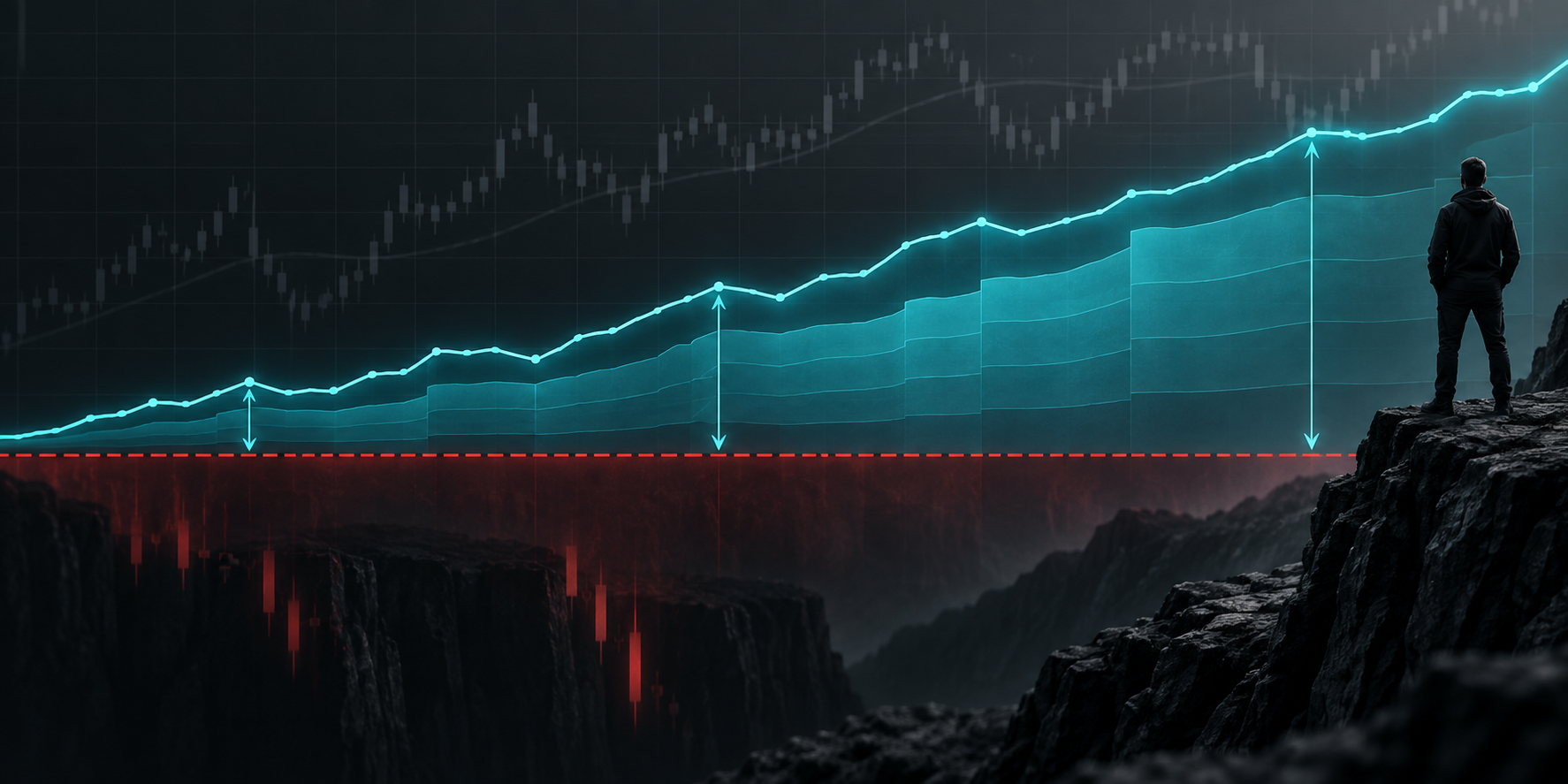
When a trader says they are building a buffer, they usually mean they are trying to create more room between the account value that matters under the rules and the account’s loss threshold. That room can make the account less immediately vulnerable to an adverse move, but it is a risk-measurement concept—not automatically a formal account milestone.
In simple terms: buffer = relevant account value minus applicable loss threshold. A positive result indicates room before that threshold is reached; a smaller result means less room. The important qualification is that both parts of this equation are defined by the firm’s specific program rules.
Do not assume that “buffer” is an official defined term or that every account uses the same calculation. The relevant account program and platform documentation should control.
The numbers that matter are not always the displayed balance
A dashboard balance can be useful, but it may not be the number used for loss-limit compliance. A firm may assess a threshold against balance, equity, realized P&L, unrealized P&L, an intraday high-water mark, an end-of-day value, or another defined measure. Commissions, fees, open positions, and the timing of updates can also matter under a particular rule set.
For example, assume purely for illustration that the applicable threshold is $98,000 and the relevant value is $99,200. The illustrative buffer is $1,200. If the firm instead includes an open trade’s unrealized loss and relevant equity falls to $98,400, the buffer would be $400.
This is why a trader should not calculate cushion solely from closed-trade profit unless the applicable rules say realized balance is the measure. A profitable account can still be close to a threshold if open-position losses are included.
Why drawdown design changes the buffer
A static threshold generally stays at a stated level unless another rule changes it. Under that design, profits may increase the distance above the threshold because the threshold itself does not move. That does not mean profits are automatically withdrawable or that position limits change.
A trailing threshold can rise as the account reaches new relevant highs. Depending on the program, it may trail intraday, update at the end of the day, use equity or balance, and stop moving at a specified point—or it may follow another method. A trader can make profits while gaining less permanent room than expected if the threshold rises too.
An end-of-day approach can produce a different result from an intraday approach because the point at which the firm records the high-water value matters.
A larger buffer is not permission to trade larger
More distance from a loss threshold can reduce immediate proximity to a breach. It does not, by itself, change a contract limit, scaling rule, position limit, account status, or other trading permission. Those are separate program terms where they exist.
NQ1! Market Snapshot
Reported Market State
Auction Activity
Rejecting Lower Prices
Market context
As of Sep 25, 3:00 PM CDTPrice is inside the current value area and above RTH VWAP.
- Nearest mapped level: OR15 High (30,890.00), 1.50 points below price.
- Price is above the prior value area.
- Reported auction activity: Rejecting Lower Prices.
- New York session range: 9.34 ATR. Net displacement: +2.53 ATR.
Market location
- Current value
- Inside
- Prior value
- Above
- RTH VWAP
- Above
- Prior RTH VWAP
- Above
Nearby levels
- OR15 High30,890.00
near · 1.50 pts · 0.05 ATR · Price above
- VWAP +1 SD30,905.48
extended · 13.98 pts · 0.49 ATR · Price below
- Asia High30,906.00
extended · 14.50 pts · 0.51 ATR · Price below
- Point of Control30,914.00
extended · 22.50 pts · 0.79 ATR · Price below
Level clusters
VWAP +1 SD / Asia High
30,905.48–30,906.00
Midpoint 14.24 pts from price · 0.50 ATR to midpoint
ATR Upper / Value Area High
30,931.17–30,932.00
Midpoint 40.09 pts from price · 1.40 ATR to midpoint
RTH High / Previous 4H High
30,951.50–30,951.50
Midpoint 60.00 pts from price · 2.09 ATR to midpoint
FAILED LOWER
Treat buffer as a measurement of remaining loss room, not as a target that authorizes greater risk. A single oversized position, a gap in available liquidity, costs, or an intraday loss can consume a cushion quickly. The account’s live rules and limits remain in force regardless of how much profit appears on the dashboard.
Before changing size or holding risk differently, check whether the relevant program has an explicit maximum-position, scaling, news, overnight, or other trading rule. Do not infer a change in permission from reaching a particular profit level.
A buffer does not establish payout eligibility
Profit above a loss threshold and profit eligible for withdrawal are different concepts. A trader may have a substantial apparent cushion yet still need to satisfy separate conditions, such as required trading days, consistency requirements, minimum balance or safety-net conditions, maximum withdrawal amounts, waiting periods, or other program-specific criteria.
The reverse can also matter: a payout that is permitted may reduce the remaining cushion or affect the threshold calculation under some prop-firm designs. Whether that occurs, and how it is treated, cannot be generalized to specific firms without the current rules for the exact account.
What to verify in a Prop Firm’s current rules
Start by identifying the precise product, account type, and platform. Then read the current official terms, rulebook, FAQ, and payout documentation that apply to that account. Program names alone may not establish identical drawdown or withdrawal mechanics.
Confirm the starting value, maximum loss limit, and exact threshold formula. Check whether the limit is trailing, end-of-day trailing, static, or another design; what value it follows; when it updates; whether it stops moving; and how open positions, intraday fluctuations, commissions, resets, and rule breaches are handled.
Separately confirm whether “buffer” is formally defined; whether any specified balance changes account permissions; every payout prerequisite; the maximum amount that may be requested; and what happens to balance, drawdown room, and continued eligibility after a payout. Save a dated copy or screenshot of the governing materials and the relevant dashboard values before making a trading or withdrawal decision.
A practical pre-trade and pre-payout check
Before trading, identify the live loss threshold, the value used to test it, and the resulting current room. Check open exposure as well as closed P&L if the rules can incorporate unrealized results. Verify that intended position size remains within all stated limits; remaining drawdown room is not a substitute for a position-limit rule.
Before requesting a payout, verify each eligibility condition independently rather than relying on the amount above the threshold. Review the program’s current qualifying-day, consistency, minimum-balance, safety-net, cap, and timing terms where applicable. Also confirm the stated treatment of the account after funds leave it.
The bottom line: building a buffer generally means creating more separation from a loss threshold. It can be useful risk context, but at any firm it should not be treated as a universal status, larger-size authorization, or payout guarantee. The current rules for the specific account determine all three.